
The pack train moved slowly through the remaining snowdrifts of late spring in the Tetons, heading for the mountain valley ahead. The buckskin horses were led by a tall-for-his-time trapper with thick red hair and beard, whom the Shoshone called Ingapumba (redhead), but more often he was known to his neighbors as “Beaver Dick” or “Uncle Dick.”
Trapper, hunting guide, ferryman, Mexican War veteran, and all-around mountain man, Richard ‘Beaver Dick’ Leigh, lived a long life in and around the Teton Mountains. Following behind were his Shoshone wife, Jenny, and his children riding burros. They were leading pack horses loaded with supplies for a long season of camping, hunting, and trapping in the high valley known even then as Jackson’s Hole.
In his 68 years, Beaver Dick Leigh fought in the Mexican War, guided government expeditions through the Yellowstone region, led hunting parties from the East—and enjoyed life among the Shoshone and Bannock tribes. With his red hair, blue eyes, and freckles, he stood out from most of those around him, but despite his rough life, he was an inveterate reader of books, magazines, and newspapers. He kept a diary during his time in the mountains.
Richard Leigh was born in Manchester, Lancashire, England, in 1831, emigrating to America at age 7 with his sister, Martha. Eventually they moved on to Mount Hope, Pa. From there, he left his sister and joined the Hudson Bay Company, which sent him to the Northwest, where his education as a trapper began. He never looked back, nor saw his sister again, but stayed in touch, however, as he later referred to his brother-in-law, Henry Wall.
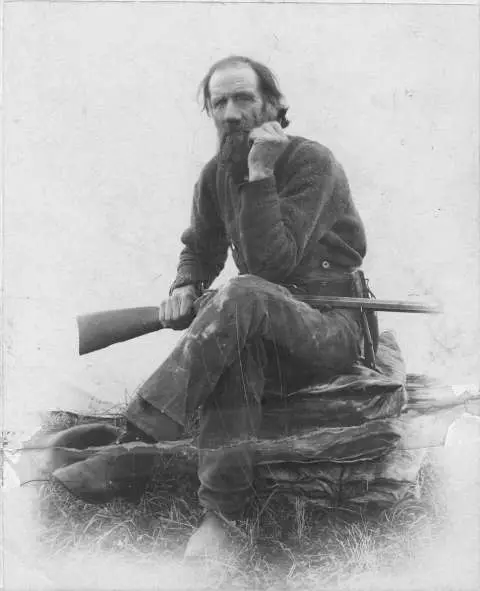
Beaver Dick joined the U.S. Army toward the end of the Mexican-American War (1846-48), in which he served under Lt. Col. Henry Wilson.
Following his discharge, he travelled to the Salt Lake Valley, where he resumed his trade as an independent trapper. Moving north into what would become Idaho Territory, he chose the Snake River Valley for his homesite. This initially meant long pack trips south for several years to sell his furs in Utah Territory.
On one of these trips to Corrine, in 1862, near the northeast shore of the Great Salt Lake, he camped near a Bannock couple—a man known as Bannock John to the whites, and his wife, Tadpole, a sister of the local Shoshone chief, Taghee. Tadpole was amid a difficult labor and Dick assisted the father in delivering the baby.
The new arrival was named Susan Tadpole. Her parents promised her to Dick to be his wife when she reached maturity, no doubt a kind gesture of gratitude that had little expectation of coming to fruition, since he was 31 at the time.
Before he returned to his base camp at the confluence of the Snake and Teton rivers on the west side of the Tetons, Dick Leigh married a 16-year-old Eastern Shoshone girl from Chief Washakie’s band in 1863. Dick called her Jenny. He often told his friends and wrote in his diary about her many good traits. Five children arrived in the following years. Dick, Jr., 1864, Anne Jane, 1866, John, 1868, William, 1870, and Elizabeth in 1873.
Dick’s homestead on the west side of the Tetons continued to expand with additions of milk cows and the buckskin horses he was fond of. When it was time to go on the annual hunting trips over the mountains, Dick took the entire family along. Leigh’s diaries give an in-depth picture of the challenges they faced on the frontier. Whether setting his trap lines, hunting with his son Dick, Jr., leading hunting parties or assisting any of the increasing number of new settlers arriving in the Snake River valley, Beaver Dick Leigh was a busy and well-respected member of the community.
He built a ferry at the Eagle Nest Ford on the Henry’s Fork of the Snake, free for anyone to use. He acted as liaison between the tribes and authorities at the new Fort Hall Reservation, advising them about Indian movements on and off the reservation.
In the winter of 1876, an Indian woman seeking food visited the Leighs. They did not know she had smallpox. All of the Leigh family and another hunter caught the disease. Between Christmas Eve and Dec. 28, all of Beaver Dick’s family died; he and the hunter barely survived.
In 1879, Dick Leigh, age 48, married 16-year-old Susan Tadpole, who had been promised to him at birth. The couple had three children: Emma, 1881; William, 1886; and Rose, 1891.
While camped near Two Ocean Creek on the Continental Divide in the fall of 1891, they were visited by Theodore Roosevelt and his hunting party. Beaver Dick and Teddy conversed for a spell, sharing stories and hunting tales.
Dick continued to guide hunting parties as long as his health permitted. Eventually, he had to turn over this business to his son William. He also kept in touch with the many friends he had made over the years, writing letters to a lengthy list of correspondents.
Beaver Dick Leigh died March 29, 1899, age 68, in the company of family and friends. He is buried beside his family on a high terrace overlooking his ranch near Rexburg, Idaho. His memory and legacy are well preserved in his letters and diaries, as well as the namesake features in the Jackson Hole valley he loved.